
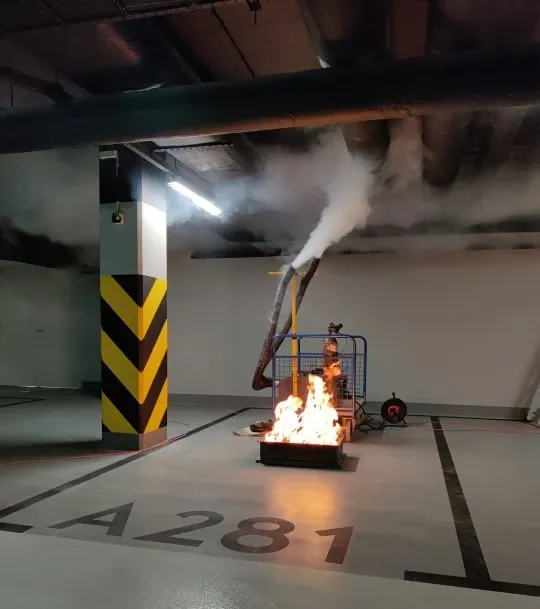
A hot smoke test in an underground car park is an essential step of the acceptance process and the key check of the smoke ventilation system. It verifies that the components of the smoke control system start correctly and in the right sequence, and that the smoke flow directions match the results of the CFD simulations.
The test rig
Professional equipment is essential - we use proven generators from the British manufacturer Pea Soup, which produce smoke of very good quality that withstands temperatures up to 180 °C. The smoke should be white, sufficient to colour the entire plume, pH-neutral and leave minimal residue.
To create the buoyancy of hot gases we add a separate heat source - trays of burning ethyl alcohol. This allows us to estimate the fire size and the temperature in the plume and the ceiling jet, and to protect other installations from damaging heat. Particular attention is paid to protecting the sprinkler system.
What to look for during the test
Tests should be carried out at the locations identified in the CFD simulations. The fire detection and alarm system must detect and locate the fire correctly - the first-stage alarm should shut down normal ventilation, and with coincidence (double-knock) detection the first detector must always indicate the smoke zone in which the fire started.
The test checks actuation of fire dampers and smoke control dampers, closing of gates and smoke curtains, and the start-up time of the main fans. Starting extract or supply too early can prevent the dampers from opening.
With jet fan ventilation, the test checks the start-up time and direction of the jet fans (with a delay that allows evacuation) and the air velocity at the boundary between smoke zones. With ducted extraction, the stability of the smoke layer is what matters, and finally - the time needed to clear the car park for reuse.
Related service