
Safety distance · domino effect
Major accident hazards
We determine safety distances from facilities that pose a major accident hazard, through consequence analysis of thermal radiation, overpressure and the toxicity of hazardous substances.
Siting
Determining safety distances
Facilities such as upper- and lower-tier establishments under the Seveso III Directive (2012/18/EU; in Poland ZDR and ZZR), liquid fuel depots and filling stations, and transmission pipelines should be located at a safe distance from each other, from residential areas, public buildings and multi-occupancy residential buildings. The requirement applies to new facilities as well as to extensions and changes of use.
A safety distance must ensure a high level of protection of human health and life against the consequences of an accident - by limiting those consequences and their escalation and by preventing a domino effect.
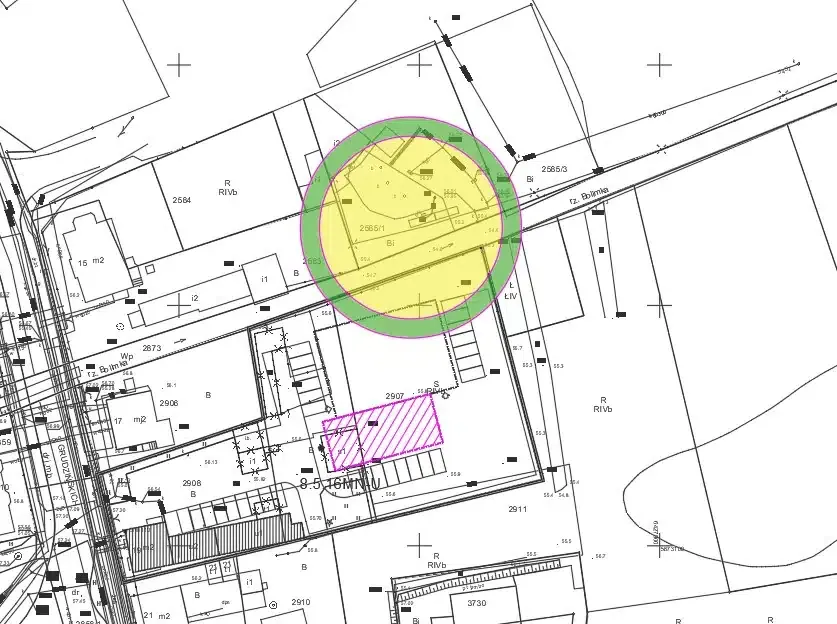
Example thermal radiation range
Scope of analysis
What we analyse
Thermal radiation
Heat flux hazard ranges from tank fires, jet fires and pool fires - determined for threshold intensity values.
Overpressure
Consequences of vapour cloud explosions (VCE) and other explosions - blast wave ranges for harm criteria for people and structures.
Toxicity
Dispersion of hazardous substances and the extent of toxic concentrations in the atmosphere, taking meteorological conditions into account.
Determining a safety distance requires choosing the right threshold parameters and carrying out engineering calculations. These in turn call for knowledge of chemistry, physics, hazard identification, risk analysis, safety management and fire safety engineering - needed both to carry out the analysis and to draw the right conclusions.
Contact
When to get in touch
- you are planning a development near a facility where a release, fire or explosion of hazardous substances may occur
- you operate an industrial plant and are planning to extend it
- you are planning changes to local zoning plans near industrial sites or for industrial use
Facility or development in a hazard zone?
Describe the location and the substances involved - we will prepare a hazard and safety distance analysis.