
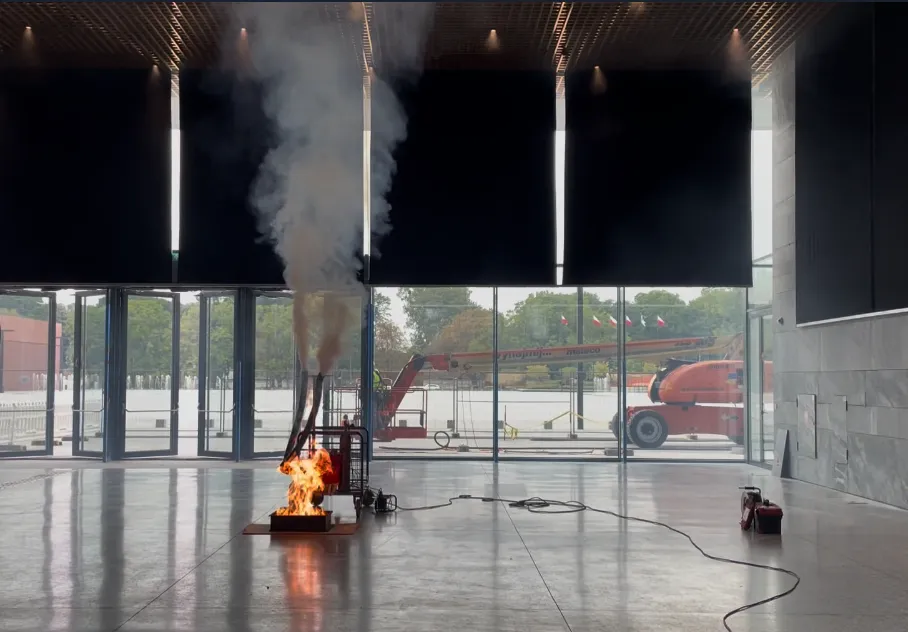
Hot smoke tests in entrance lobbies are particularly important - in many buildings, evacuation from the upper storeys leads through a smoke-ventilated entrance lobby. The test confirms that occupants can leave the affected area under reduced visibility and high temperature.
Why lobby tests matter
Entrance lobbies play a key role in the escape route system. In a fire, these spaces must be cleared of smoke quickly and effectively for evacuation to be safe. Hot smoke tests reproduce fire conditions realistically, verify the performance of the smoke control system and show where it needs to be modified.
How the tests are carried out
As in stairwells and car parks, specialist smoke generators are used to produce smoke of a defined temperature, density and buoyancy, which reproduces real evacuation conditions. The smoke should spread evenly across the lobby so that the fire and smoke ventilation systems can be tested.
What is verified
- performance of the smoke control system - whether it removes smoke quickly and effectively and maintains visibility
- activation time of the smoke control system after smoke detection
- whether smoke spread matches the assumptions of the computer simulations
Summary
Hot smoke tests in entrance lobbies are essential to assess the performance of smoke control systems. They reproduce evacuation conditions realistically, expose design weaknesses and raise the overall level of safety. Every test is followed by a report, which in Poland is used during the acceptance inspection by the State Fire Service (PSP).
Related service